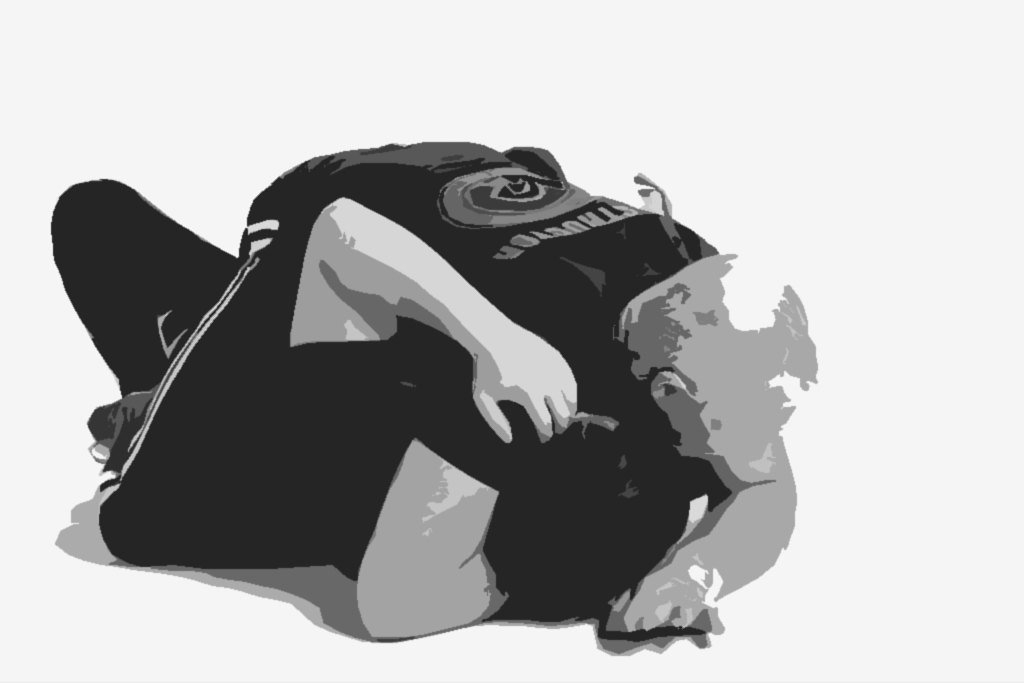
What defines Combat Grappling
Combat Grappling focuses on the situations most likely to occur when a confrontation enters close range or goes to the ground.
This includes:
- Loss of balance during a struggle
- Attempts to clinch, wrestle, or pin
- Accidental or forced takedowns
- Entanglements where space and mobility are limited
Rather than extended ground exchanges, the emphasis is on positional safety, awareness, and the ability to disengage when possible.
Core priorities
The defining priorities of Combat Grappling differ from sport-based grappling systems.
Key priorities include:
- Maintaining balance and posture under pressure
- Avoiding unnecessary ground engagement
- Regaining a dominant or stable position quickly
- Managing weight, leverage, and strikes during grappling
- Preserving awareness of the wider environment
Control is valued over complexity, and reliability under stress is prioritised over technical breadth.
Close-range control and takedowns
Close-range exchanges often begin from striking distance. As space closes, people grab, collide, or try to force the other person off balance. Combat Grappling addresses how to control this transition and deal with takedowns when strikes are still a factor.
This area focuses on:
- Controlling an opponent once distance has closed
- Using strikes to enter safely into the clinch
- Managing balance while absorbing or delivering strikes at close range
- Taking a striking opponent to the ground when needed
- Defending against takedown attempts while remaining upright
Rather than separating striking and grappling into different phases, Combat Grappling treats them as overlapping problems that must be managed together.
Common takedown methods include:
- Single-leg and double-leg takedowns adapted for striking range
- Takedowns from underhooks and body locks
- Off-balancing and trips from close contact
- Forcing an opponent to the ground using pressure and positioning rather than speed
The emphasis is on control and stability rather than explosive or risky entries. Takedowns are used to create safety and positional advantage, not to chase a sporting outcome.
Ground control and positional hierarchy
When the fight does go to the ground, Combat Grappling emphasises positional hierarchy rather than submission chasing.
Common positions include:
- Mount with strong base and posture
- Side control using pressure and frames
- Back control with simple, stable grips
- Knee on belly to maintain mobility and space
Position, base, and pressure are established before transitions or control techniques are applied.
Striking awareness within grappling
Unlike sport grappling, Combat Grappling assumes the presence of strikes throughout clinch and ground exchanges.
This affects:
- How posture is maintained
- How positions are held
- How transitions are executed
- How escapes are prioritised
Techniques are selected and adapted to reduce exposure to strikes and maintain defensive awareness at all times.
Submissions as control mechanisms
Submissions exist within Combat Grappling, but they are treated as tools for control rather than competitive finishes.
Emphasis is placed on:
- High-percentage strangles from dominant positions
- Guillotine variations from standing and sprawls
- Arm triangle pressure from top control
- Kimura control as a lever or restraint
Application prioritises balance, posture, and situational awareness rather than prolonged engagement.
Escapes and recovery
Escaping inferior positions and returning to a safer posture or standing position is a central component of Combat Grappling.
Key concepts include:
- Bridge and roll mechanics from mount
- Elbow knee escapes to half guard or space
- Back escapes using hand fighting and hip movement
- Technical stand-ups under pressure
- Recovery after failed takedown attempts
The objective is to minimise time spent in vulnerable positions.
How Combat Grappling differs from sport grappling
Although there is technical overlap with Brazilian Jiu Jitsu, wrestling, and submission grappling, Combat Grappling operates under different assumptions.
Key distinctions include:
- No assumption of a single opponent
- Continuous awareness of strikes
- Emphasis on disengagement over domination
- Consideration of fatigue and uneven terrain
- No reliance on sporting rules, rounds, or time limits
The measure of success is functional safety and control rather than competitive outcome.
Combat Grappling within Krav Maga
Combat Grappling is commonly taught as part of a wider Krav Maga framework, alongside striking, scenario training, and self-defence principles.
Within this context, grappling skills are integrated to support decision-making, positional safety, and practical resolution of close-range threats.