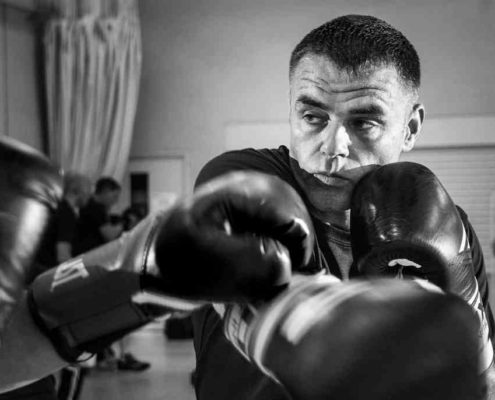
What makes Krav Maga different
Krav Maga is designed for real world violence rather than sport or tradition.
Training focuses on:
- Practical responses to common real world attacks
- Moving between striking, clinch, and grappling as situations change
- Awareness of weapons, multiple attackers, and environment
- Simple actions that hold up under stress and fatigue
- Decision making under pressure, not memorising long sequences
- There are no sporting objectives, time limits, or win conditions.
- Training is structured for safety, but techniques are chosen for real world relevance rather than competition rules or tradition.
Where Krav Maga comes from
Krav Maga draws from proven combat disciplines, including:
- Boxing
- Wrestling
- Judo
- Muay Thai
- Brazilian Jiu Jitsu
- Modern MMA
These elements are adapted specifically for self defence, where there are no rules, no referees, and no guarantee of a fair encounter.
Civilian self defence focus
Although Krav Maga began as a military system, civilian training focuses on the most common real world threats, such as:
- Unarmed assaults
- Grabs, headlocks, and chokes
- Close range confrontations
- Situations involving more than one attacker
The objective is always the same. End the threat quickly and create an opportunity to escape or take control.
You can see how this is trained locally on our Self Defence Classes in Bristol page.
How Krav Maga is trained
Krav Maga combines striking, grappling, and situational awareness into a single system.
Training typically includes:
- Striking using boxing and Muay Thai fundamentals
- Clinch and grappling based on wrestling and Brazilian Jiu Jitsu
- Defence against common grabs and chokes
- Scenario based drills that introduce stress and unpredictability
Groundwork is included only where it makes sense for self defence. The priority is staying mobile and returning to your feet safely.
An adaptable system
Krav Maga is not fixed or traditional. It evolves based on:
- Real world incidents
- Changes in threat patterns
- Improvements in training methods
Modern programmes often include strength, conditioning, and padwork to support performance under fatigue and stress.
How we teach Krav Maga in Bristol
At Bristol Titans, we teach Krav Maga as a functional self defence system rather than a stylised martial art.
Our training is shaped by real world data and experience. Because many violent encounters involve weapons or more than one attacker, we include these factors in training rather than ignoring them.
Krav Maga draws on proven combat disciplines including boxing, Muay Thai, wrestling, judo, and Brazilian Jiu-Jitsu. These provide a pressure-tested foundation for striking and grappling, which we then adapt for self-defence situations where there are no rules, no referees, no weight classes and no guarantees.
Training includes:
- Sound striking and grappling mechanics
- Controlled sparring
- Clinch and close range work
- Pressure testing to develop decision making under stress
Our coaching background includes Muay Thai, MMA, and front line security work, which directly informs how we train.
Krav Maga classes in Bristol
We run structured Krav Maga classes for:
Sessions are scaled to experience level and focused on building confidence, fitness, and real capability.
If you want to know what to expect, visit our FAQ. To hear directly from students, read our Reviews.